
Local Procedures
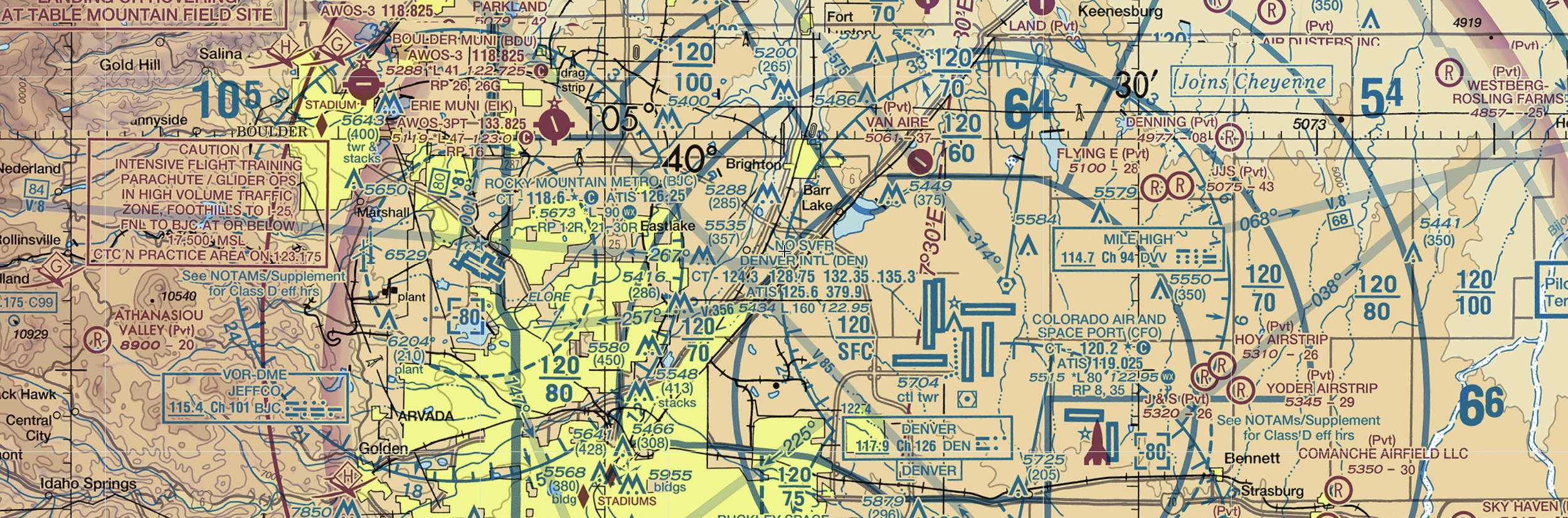
It’s no secret Denver is a busy and beautiful place to fly. Whether it’s Part 121 traffic going to Denver International (KDEN), gliders flying over Boulder (KBDU), medevac flights from Centennial (KAPA), or helicopter training out of Erie (KEIK) the missions of pilots throughout the Denver airspace is quite varied. We also have a high volume of flight training under the western side of the Class B shelf and mountains! It may sound intimidating, but we see pilots adapt to it quickly every day.
Fortunately several organizations including the FAA and Colorado Pilots Association (CPA) have put together some helpful resources to help us navigate our airspace. Please read the information below as both RMFS and the FAA require you to be familiar with all the necessary information for a given flight (14 CFR 91.103).
If you have any questions or concerns, please call us at (303) 465-4600 and schedule an appointment with a CFI.
-
Due to significantly increased traffic counts the FAA has instituted new arrival and departure procedures that are unique to our Class D airspace. It is imperative that EVERY pilot who flies with us review, understand, and comply with all of the information in the official Letter of Agreement (LOA). You can find this in your EFB or keep scrolling.
Matt Beyer, our Director of Safety, has put together this helpful video that shows how to fly the new arrival and departure procedures. For more information, please see Safety Briefings #113 through #116 at mattbeyer.com.
If you have any questions about these procedures please do not hesitate to call us at (303) 465-4600 to talk to a CFI . We want to make sure you have the knowledge and skills to maintain safety and proficiency when flying Rocky Mountain Flight School aircraft.
-
Rocky Mountain Metropolitan Airport (RMMA) began operations in 1960. The airport has a long history of community engagement including everything from airshows to 5K “fun runs” for charity. Like RMMA we strive to be good neighbors. One of the easiest ways to do that is to follow published voluntary noise abatement procedures. Please follow these whenever possible.
You can find a pdf of noise abatement procedures HERE or keep scrolling.
As always if you have any questions or concerns please do not hesitate to call us at (303) 465-4600to schedule a lesson with a CFI. Any one of our instructors would be more than happy to discuss noise abatement procedures with you.
-
We love to fly in Denver! We also strive to be respectful pilots at other airports. Check out the links below for information regarding specific airports around KBJC. Also make sure to check your EFB for any airport-specific Letters to Airmen (LTAs) or unique procedures.
Erie (KEIK): https://erieco.gov/93/Airport
Longmont (KLMO): https://longmontcolorado.gov/airport/
Boulder (KBDU): https://bouldercolorado.gov/government/departments/airport
Fort Collins (KFNL): https://www.flynoco.com/
Greeley-Weld (KGXY): https://www.flygxy.com/
Centennial (KAPA): https://www.centennialairport.com/
Letter of Agreement (LOA)
Due to significantly increased traffic counts the FAA has instituted new arrival and departure procedures that are unique to our airspace. It is imperative that EVERY pilot who flies with us review, understand, and comply with all of the information in the official LOA document below.
Noise Abatement Procedures
KBJC is surrounded by many homes and neighborhoods, so we do our best to follow published noise abatement procedures. Although the procedures are voluntary, we strongly advise all pilots adhere to them whenever possible.
The Denver Class B airspace is popular for all kinds of flying. Just on the west side of the Denver we have roughly 8-10 flight schools using the same 20-30 square mile area for all kinds of flight training. The Colorado Pilots Association has worked with the FAA and local groups to develop practice areas to better organize traffic. We highly recommend all students and renters download the overlays for popular Electronic Flight Bags (EFBs) like ForeFlight and Garmin Pilot. The Colorado Pilots Association (CPA) website has a very helpful guide on how to do this. You can find the .XML files below or download them directly from the CPA website.
Additionally, the FAA has instituted arrival and departure routes for all traffic to help control flow in and out of the Class D. You can find the original document HERE.
Our Director of Safety, Matt Beyer, has done a great job of compiling other helpful documentation on his website.
Our Local Procedures page has additional information regarding our airspace. Make sure you get instruction on local airspace procedures from one of our CFI’s if you have not flown in the area before.